Women in Bastan Village, Kurdistan
Showing posts with label violence against women. Show all posts

Sunday, May 5, 2013

In Iraqi Kurdistan those who Murder Women go Free

"There is definitely a light at the end of the tunnel. And we are here for the long haul." - Hoda Elsadda

Zhiyan group representatives are never satisfied; they never rest when it comes to women’s issues. Last week they had a press conference to release results of a study about the impact of the so called “Amnesty Law”  in cases of violence against women. The week before, they were in Kalar, Germian, to follow up the case of Nigar Rahim; a 15 year old raped by one of her brothers and murdered by another. I am not able to keep up with all of their work as I have an important role in documenting their work for our english speaking readers. Their meetings, events are always in Kurdish, but they always keep me involved despite the language barrier. I think is extremely important to have their work connected to the broader women rights struggle.

The meeting in Kalar was very positive, six representatives from Zhiyan group met with the investigator in the case of Nigar Rahim, along with many representatives of women organizations in Kalar. The organizations in Kalar expressed their readiness to be more active in Zhiyan group and to this end they selected a coordinator for the Germian area.
Meeting of Zhiyan Group in Kalar, Iraqi Kurdistan. Photo supplied by Zhiyan Group.
Last year, Prime Minister Nechirvan Barzani established an investigation committee to follow up the case of Nigar. The group was composed by the case investigator, a representative from NGO’s, a representative from the High Committee of Women and a representative from the Directorate to Trace Violence Against Women (DTVAW). The group wrote a 2-page paper with recommendations about Nigar’s case and emphasized the need for a women’s shelter in Germian. Until now, the Prime Minister has not answered the committee regarding their recommendations.

The outcome of the meeting in Germian was very good, with NGO’s wanting to organize a demonstration to demand shelters in the area and the commitment to be present in the court hearings of Nigar’s case.

Zhiyan group also organized a press conference on May 5th in Culture Cafe, Suleimaniya. Under the title: “No to the release of women murders under the general Amnesty Law”, Zhyan group presented a new report which focuses on the release of women murders under the general Amnesty Law. The amnesty law has been controversial among various sectors of civil society, including women groups. The law is affecting women victims of violence in a significant way.

At the press conference on May 5th in Culture Cafe, Suleimaniya, Kurdistan-Iraq
During the press conference, two members of Zhyan group presented the report which was prepared by DHRD. On 10th October 2012 a short version of this report was submitted to the presidency of Kurdish Parliament warning them about the dangers of this law on the women’s [rights] situation but there was no positive reaction .


Zhian group reported that 7 women murders were released because of this law among them the father of Sakar, a teacher who was killed by her father in 2012 .

The report reveals that perpetrators that are released under the amnesty law continue to commit crimes. This is the third time since 2003  that the amnesty law is in place. Women activists explained that honor killing is excluded from the amnesty process but that is easy to classify honor killings as another type of crime, They explained that the law is politically motivated is being implemented during the election process in order to buy votes. Zhiyan group members expressed the negative attitude that judges have towards women groups. In some instances when members of Zhiyan group attend the court hearings they are “laughed at” by lawyers or others because they are sure that perpetrators will “go out under the amnesty law”.


Notes: “According to non-official data, since 1991 about 10,000 have been killed for different reasons of so called “honor”.  According to the Iraqi penal code in case a male member of the family kill a woman he can get less charge as exception under so called honor killing. In Iraqi Kurdistan this article of penal code was amended and no more women murderers benefit from any exception. This is a big improvement and is why activists from Zhyan group are advocating for the implementation of the law.“

Sunday, April 28, 2013

Zhiyan Group: Releasing Sakar's father is perpetuating the patriarchal structures that discriminate against women

Suleimaniya, Iraqi-Kurdistan April 28th, 2013


Last week, on Monday, April 22nd, women groups demonstrated in front of Suleimaniya Court.

They were protesting the release of Mamosta Sakar’s father. In a controversial case well know to the media and to most people in Kurdistan, the case of Mamosta Sakar has become an icon
of struggle for women’s rights in Kurdistan. The perpetrator of the crime, her father was released for the second time after the court ruled that he can benefit from the general pardon granted by the Amnesty Law passed by the Kurdish Parliament last year.


Zhiyan group, which has been following the case and represents many women groups released this statement to the media during the demonstration:

During the past 20 years the killing and genocide of Kurdish women has become a daily life phenomena. The increase in this type of crime has made authorities including courts and local authorities to deal with the issue as a normal thing. The killing of women is a source of fear for the Kurdish society but what is most fearful is that criminals along with the authorities, including the parliament accept the crimes without punishment.

The case of Mamosta Sakar is an example that proves this reality. Despite all evidence presented in the court that the crime was committed by Sakar's father, the crime went unpunished. We, as Zhiyan group are working to defend women's rights and showing the reality of women in Kurdistan. We do not get any benefit in doing so. We have put all the evidence in front of the court, but the Suleimaniya Criminal Court, without looking to our efforts to uncover the reality, decided to apply the general amnesty law, approved by the Kurdish Parliament and signed by president Mazoud Barzani on 2012.


Zhiyan group wrote and delivered a letter with the case details to Suleimaniya's investigator's office asking the case to be appealed to the Committee of Court and Law. We ask for the revision of the case and a fair trial. We are calling all local and international organizations and the people who are defending women's rights  to pressure the court council to have a fair trial and not to deny the crimes committed against women.

Zhiyan Group
April 22nd, 2013

PS: I keep my efforts to document and be solidary with the work of Zhiyan group in an effort to make the struggle of Kurdish women, and women in Iraq known to the Global Community.

Justice for Mamosta Sakar and for all women in Kurdistan and Iraq!


Thursday, March 7, 2013

International Women's Day in Kurdistan-A year's review


A woman with a voice is by definition a strong woman. But the search to find that voice can be remarkably difficult. Melinda Gates

Tomorrow is International Women’s Day. For the past weeks, as women activists prepare for the 8th of March, I would like to make a contrast between last year’s 8th of March in Suleimaniya and what makes this year different.
For the last year, women activists have been working on the issue of honor killing. Honor killing means that a woman is killed to clean the family’s honor; this honor could have been stained if the woman was doing something that is disapproved by her family. That could include marrying a man not approved by her family, or not marrying one that is chosen for her, and even rape is seen as dishonor to the family. Honor killing has a long history in the Kurdish society, especially since 1991. At that time, there were no institutions, court or police. The law favored those who kill women for honor. Nowadays, there are institutions, judiciary and police, yet they are not successful in protecting women. Moreover the same laws that are supposed to protect women still discriminate and stigmatize them. Despite the Kurdish Parliament high number of women representatives (36 of 111) and the Domestic Violence Law approved last June 21, 2011, which criminalizes domestic violence, Kurdistan is far from achieving justice for women who are victims of violence. The law has been approved but in reality is not enforced as it has proved difficult to implement these reforms in a society governed by tribal honor codes, where tribal leaders continue to be the most powerful and influential actors when resolving family conflicts.
Many things have changed in a year, although most of the time I am frustrated because I see no progress in the situation of women here in Iraq, there IS a difference. Last 8th of March we had a demonstration in front of the Suleimaniya court. We had banners demanding the end of women killing, the establishment of shelter and support services for women in the villages, and condemning violence against women. We were very few, maybe 25-30 people. We had more Assaish (Kurdish security) than demonstrators. Last year, the government had declared the 8th of March as the Kurdish national clothes day. News coverage showed women in their Kurdish traditional clothes, dancing to the traditional Kurdish music; women organizations were furious. How was it possible to use a day for advocacy for women’s rights to display women wearing traditional clothes?
International Women Day in Suleimaniya-2012,  Iraqi-Kurdistan

At that time the women’s movement was divided, and despite there were other events, all were with scarce participation. Yet the murder of Mamosta Sakar Hamdamin was the drop that filled the glass. Sakar, a 28-year-old teacher from Rania, was killed by her father on February 4th 2012. Mobilization was necessary and immediate; “Not for Honor Killing under the Name of Tradition and Culture: Mamosta Sakar Campaign” started in mid-February and has since then transformed the women’s movement in Kurdistan. The campaign took Sakar’s murder case as a means to advocate for the prosecution of perpetrators of honor killing and to denounce the lack of implementation of Law No. 8: the Law Against Domestic Violence in Kurdistan. Moreover, the campaign is demanding government’s action to stop violence against women. Women activists criticize the lack of a true place of shelter for women victims of violence and the neglect in handling court cases of violence against women.
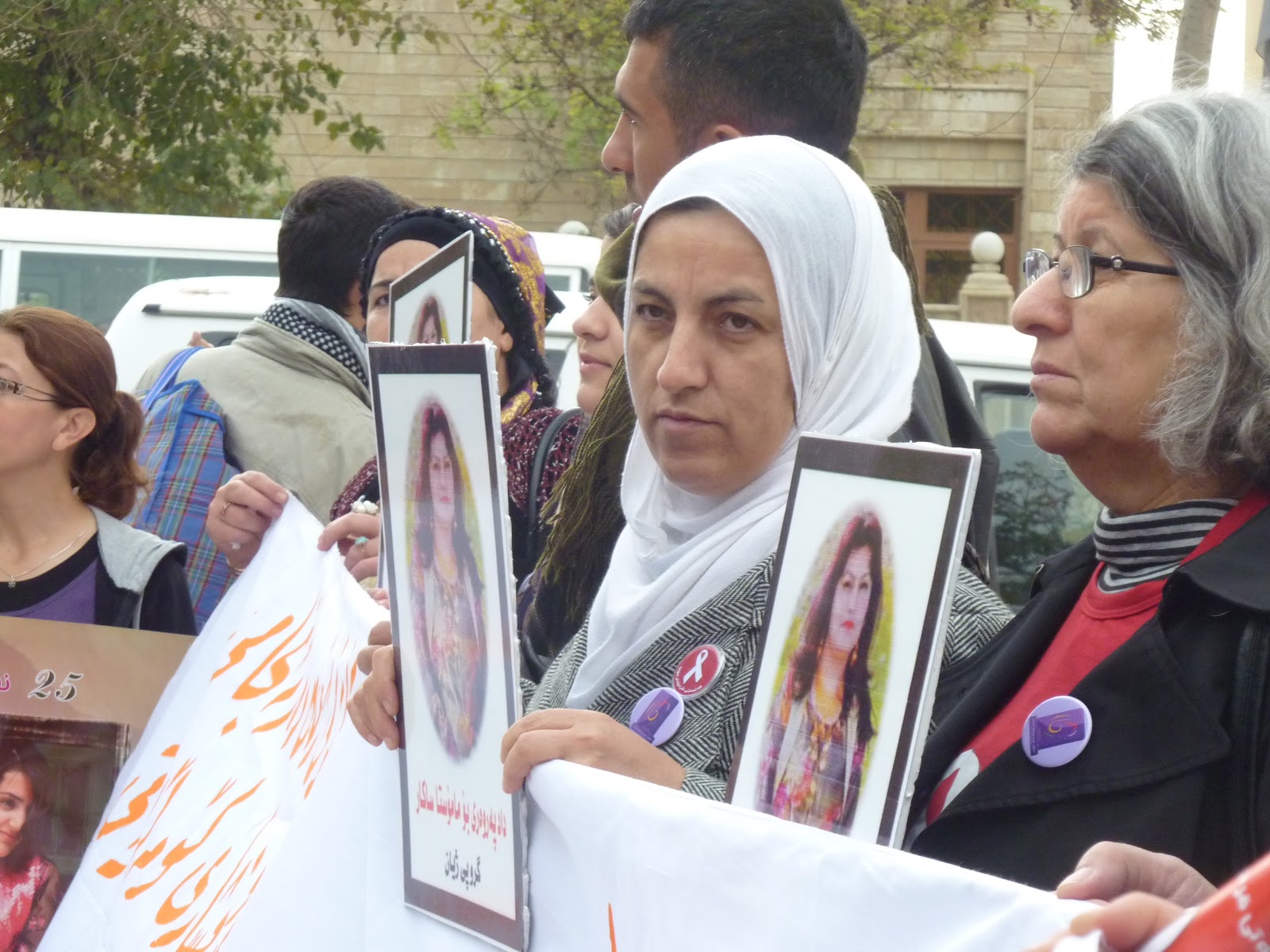
A baby hold the picture of Mamosta Sakar, November 25th,
International Day to End VIolence Against Women, Suleimaniya, Iraiq-Kurdistan


Activists and women rights advocates met with the Justice Minister, the High Committee of Women, wrote articles in the newspaper, appeared in TV programs. By the summer 2012, the campaign published a report documenting their efforts: “Not for honor killing in the name of tradition and culture” which included publishing the results of a survey about perceptions of violence against women.

On July 20th, a 15-year-old girl named Nigar Rahim from Kalar, was murdered by her brother. Nigar’s case was horrendous; one of her brothers raped her, she was pregnant, gave birth to a child, was living in a shelter, where she was under the protection of the government, while her brother’s case was in the court. Then, her family pledged not to hurt her if she was sent back home. The shelter made an agreement and the family signed the consent. A few weeks later, she was murdered by her other brother.

Nigar’s case outraged the women’s movement. They called for demonstrations in Germian, denouncing her murder and accountability from the government. By August 2012, Zhiyan group, a coalition of around 60 NGO’s was established to speak out against honor killing and to follow up these cases. This coalition is composed of women activists, and lawyers who took on both Sakar and Nigar cases. They have been present in the hearings, and actively followed up the cases. Zhiyan Group members are men and women who are taking a stand to speak out about this sensitive topic, much of a taboo in Kurdish society. The groundbreaking nature of Zhiyan Group is that it seeks long-term solutions and accountability from the government putting pressure to prosecute those who commit crimes against women.
The establishment of Zhiyan Group did not happen on a vacuum but is the response to the atrocities and crimes against women. It has been the product of long months of work of women organizations that have been able set differences apart and create a “women’s movement” on the basis of the zero tolerance for honor killing. Under Zhiyan, organizations have been able to mobilize, call for demonstrations, and attend cases hearings, creating a strong voice that has already been heard by government officials.

All of this has been welcomed by a bittersweet taste to activists, that have been criticized by conservative sectors of the society, especially from the villages where these crimes are committed. It has also been challenging from the judicial perspective, as it is the first time that women NGO’s are engaging the legal system, and both judges and lawyers are under pressure by civil society.
It has been incredible to see how much has happened in a year, how from a few we have become a lot. The work is not easy, speaking against honor killing is not seen as something approved by society and some of my colleagues have been threatened; yet that doesn’t discourage them to keep working for justice and the end of violence against. Now, I can’t wait for Friday.


Remember the dignity of your womanhood. Do not appeal, do not beg, do not grovel. Take courage, join hands, stand beside us, fight with us.
Christabel Pankhurst


Monday, November 26, 2012

Women, Life and Freedom in Kurdistan, International Day to End Violence Against Women


"Millions of women and girls around the world are assaulted, beaten, raped, mutilated or even murdered in what constitutes appalling violations of their human rights. [...] We must fundamentally challenge the culture of discrimination that allows violence to continue. On this International Day, I call on all governments to make good on their pledges to end all forms of violence against women and girls in all parts of the world, and I urge all people to support this important goal."
Secretary-General Ban Ki-moon
Message for the International Day for the Elimination of Violence against Women

25 November 2012

Women's activists have marked 25 November as a day against violence since 1981. This date came from the brutal assassination in 1960, of the three Mirabal sisters, political activists in the Dominican Republic, on orders of Dominican ruler Rafael Trujillo (1930-1961).


Today, the International Day for the Elimination of Violence, is a day to remember those women who have fallen victims of violence. Here in Iraqi-Kurdistan, women know violence very well; they are killed in honor related violence, as a cleansing for family’s honor. That is acceptable in Kurdish society, dominated by patriarchal and tribal customs.  If a woman is a “bad woman”, she is to be killed; the problem is that being a bad woman means not submitting to local customs of early or force marriage, or even being raped.

Today, in Suleimaniya, in Iraqi-Kurdistan, women, men and children gathered to hold a memorial for those women killed in honor related violence, among them Mamosta Sakar (28) and Nigar (15), killed earlier this year. Suleimaniya, in one hand is one of Iraqi-Kurdistan more progressive cities, with a lot of women advocating for freedom and equality, on the other hand it has to deal with one of the highest incidence of honor killings.

Memorial for Kurdish women victims of honor killings
Children were also speaking out against violence
 The memorial testified to the continuous women injustice in the form of rape and murders. Men stood around looking at the names laying on the floor besides flowers and women shoes. Holding banners and pictures on the street, people stopped Suleimaniya’s main street traffic for a couple of minutes, chanting “ Women, Life, Freedom” and “ Stop the Killing of Women”. One of those caught in traffic yelled: “Four women are worth one man”.

On the sidewalk, some children also gathered holding the pictures of the women murdered and even a little girl, maybe a year old joined them, holding in her little hands the picture of Mamosta Sakar as if saying: I am protesting the killing of women, I want to have my rights when I grow up. The event closed with participants letting free white balloons on to the sky, symbolizing the white ribbon campaign. 
Women and men stopped traffic on Suleimaniya's Main Street to demand the end of women killing and freedom and respect for women. November 25th, 2012


My voice counts, stop killing women in Kurdistan.
Photo by Johanna Rivera, People Development Association, Suleimaniya, Iraqi Kurdistan
A baby holding a picture of Mamosta Sakar, murdered by her father in the village of Sarkapkan on Feb. 5th 2012
Photo by Johanna Rivera, People Development Association, Suleimaniya, Iraqi-Kurdistan

The White Ribbon Campaign (WRC) is the largest effort in the world of men working to end violence against women (VAW). In over fifty-five countries, campaigns are led by both men and women, even though the focus is on educating men and boys. Photo: Johanna Rivera

Women rights organizations that organized this event are part of Zhiyan Group, a group that was formed in August 2012 with more than 60 organizations that are advocating against honor killing in Kurdistan.

How long are we going to keep silence and be complicit against the killing and violence against women?

From peace at home to peace in the society
Bahar Munzir, reading the press release about the activities in the International Day to End Violence Against Women. The activities will be running for 16 days.

Saturday, April 2, 2011

Eat, Love and Pray in Iraqi-Kurdistan--031411, Erbil, Iraqi Kurdistan

Drinking my tears of anger, frustration and sadness. I don’t know how to deal with all the realities that I have in front of me. Many peoples; many stories. Stories that I am part of, but I wish they were not happening. Not even violent stories or people being hurt physically. It’s all an internal struggle for survival. A struggle to survive in a very tough environment, full of discrimination, fear and violence against women.

A Kurdish guy, frustrated because he is not able to provide better for his family, a very low salary job, his son with a very uncommon disease, trapped in a life that he can’t manage, overwhelmed by the political situation, a corrupted government that imprisons, torture and suppresses all opposition, despite calling itself a democracy. He does not see a way out. He wants to provide a good education and good opportunities for his children, but how.

A Kurdish girl, who’s living in constant fight with the society around her. She challenges the conventional wisdom that a girl needs to marry and take care of her husband and children. She wants to be independent, travel and learn how to help other women that are facing the same challenges as her. She doesn’t like to wear the veil, but she forced to, for the sake of not harming her family’s reputation. Her job is very stressful and challenging. She is constantly afraid of making mistakes and making her boss angry. She hopes to find an ideal man that can understand her and can be open to the fact that she wants to continue working and wants to travel and know the world.

A guy from Baghdad-an internally displaced person-like many here in Erbil, he came running away from violence and trying to survive inside Iraq (as an Iraqi and is extremely hard to go abroad). He used to have a clothes shop in the market in Baghdad, but because all the violence and explosions, the market was closed. He is away from his family; both his parents are sick. His brother in law is in jail and his sister has 4 children. He has not married because he does not have enough money to pay the dowry to be able to get a wife. He left school at an early age to work. Now, alone and away from his loved ones, not speaking the [Kurdish] language-which leaves him with less work opportunities- he has to survive in odd jobs, working 17 hours a day. He cannot complain and has to accept this, otherwise he will not be able to stay in Erbil and has to return to Baghdad.

An Iraqi girl, who also is fighting the society, she is charming and beautiful, very independent and speaks herself out. She fights for her right to be free and independent, in a society that criticizes those two qualities if seen in a woman. She struggles to keep a good job and to be able to be out of the controlling eye of her supervisor that follows her in every step, and tries to decide for her what is good or bad.

Aother Iraqi girl, she confronts a conservative society that dictates the rules that women have to follow. She says there is a line and you have to walk in that line, you have to respect society. She tries to keep herself busy to hide her emptiness. She dreams of going abroad to find her freedom. She does not blame her family whom she says are very supportive and open. She loves fashion and has found here in Kurdistan a place where she is free to wear what she wants without fearing the society’s criticism. She is very kind and loving and wishes to find a husband that takes care and understands her.

A society that still operates on a tribal base and that calls itself a democracy. A system that favors only some; those who are supporters of the ruling elites. Everything is controlled by a few that hold the power and benefit from the resources of the country. The government is opening the door for foreign investment because of its own interest and benefit, but this has its consequences: a very traditional society opening to development and globalization but yet close-minded. We don’t know yet how this will impact Kurdish society, but what we know is that this rapid economic growth brings injustice; there is no equality in the redistribution of income.

Weak institutions that only serve the interests of the few, the few that have connections to those with power. If you need something done, you need contacts, or otherwise, things are really hard to manage. On the entrance of the Ministry of Interior, where I went to get my visa, there is a woman with her children crying for help, she does not have any connections, nor she knows anyone in the government who can help her. While there are a lot of foreign workers who come to improve their life opportunities here, there are some locals, often women and children, begging on the street. I told my co-worker, if we keep going out, we will be broke, because every time we go out, there is a person who is asking for money.

International Organizations that only seek to stabilize the government because is on their best interest to have a “democracy” on an oil producer country. They are investing millions of dollars in “peace building” and “democracy promotion”, but people is too busy worried on trying to stay warm in the winter and cool in the summer, trying to get a job to provide for their family.

I guess I am upset in a way. At least I have many opportunities, as I happen to live in a democratic country [I didn't have a choice]. I can travel freely, follow my dreams…..but my friends here can’t [they didn't get to choose either].

This is a beautiful country, with a rich history, culture and great people, but also a sad history of war, genocide and fighting. My only wish is that democracy will come to Kurdistan from a freely elected government, not from fear of the past or tribalism. There is a need for the development of strong institutions that support civil society and participation in an environment that is inclusive of all, men and women. This will take time… on the meantime, I’m here, listening, sharing my sadness, tears and stories, that one day people read them and know how I feel as I Eat, Love and Pray in Iraqi-Kurdistan!!