Women in Bastan Village, Kurdistan
Showing posts with label honor killing. Show all posts

Sunday, April 28, 2013

Zhiyan Group: Releasing Sakar's father is perpetuating the patriarchal structures that discriminate against women

Suleimaniya, Iraqi-Kurdistan April 28th, 2013


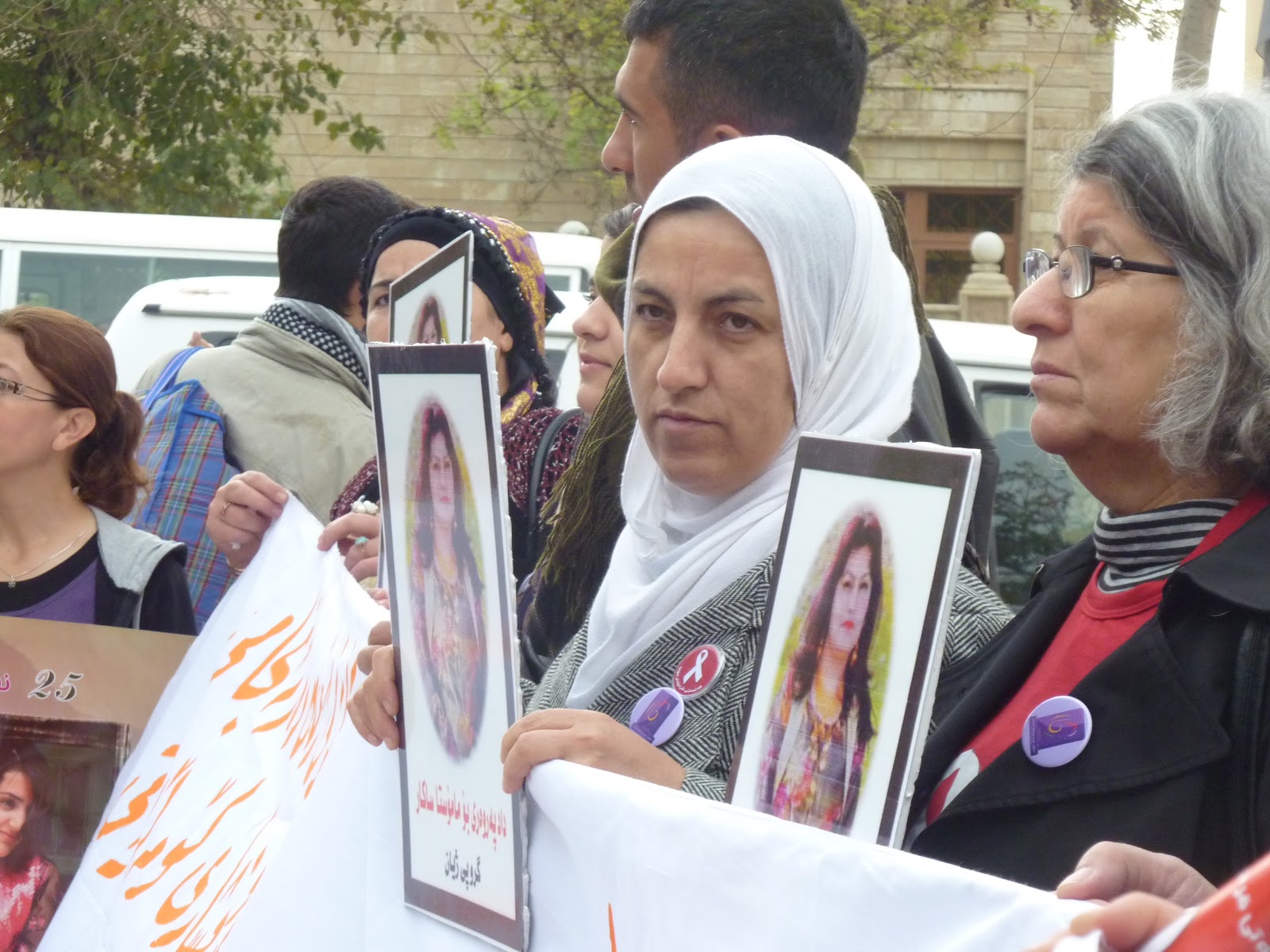
Last week, on Monday, April 22nd, women groups demonstrated in front of Suleimaniya Court.

They were protesting the release of Mamosta Sakar’s father. In a controversial case well know to the media and to most people in Kurdistan, the case of Mamosta Sakar has become an icon
of struggle for women’s rights in Kurdistan. The perpetrator of the crime, her father was released for the second time after the court ruled that he can benefit from the general pardon granted by the Amnesty Law passed by the Kurdish Parliament last year.


Zhiyan group, which has been following the case and represents many women groups released this statement to the media during the demonstration:

During the past 20 years the killing and genocide of Kurdish women has become a daily life phenomena. The increase in this type of crime has made authorities including courts and local authorities to deal with the issue as a normal thing. The killing of women is a source of fear for the Kurdish society but what is most fearful is that criminals along with the authorities, including the parliament accept the crimes without punishment.

The case of Mamosta Sakar is an example that proves this reality. Despite all evidence presented in the court that the crime was committed by Sakar's father, the crime went unpunished. We, as Zhiyan group are working to defend women's rights and showing the reality of women in Kurdistan. We do not get any benefit in doing so. We have put all the evidence in front of the court, but the Suleimaniya Criminal Court, without looking to our efforts to uncover the reality, decided to apply the general amnesty law, approved by the Kurdish Parliament and signed by president Mazoud Barzani on 2012.


Zhiyan group wrote and delivered a letter with the case details to Suleimaniya's investigator's office asking the case to be appealed to the Committee of Court and Law. We ask for the revision of the case and a fair trial. We are calling all local and international organizations and the people who are defending women's rights  to pressure the court council to have a fair trial and not to deny the crimes committed against women.

Zhiyan Group
April 22nd, 2013

PS: I keep my efforts to document and be solidary with the work of Zhiyan group in an effort to make the struggle of Kurdish women, and women in Iraq known to the Global Community.

Justice for Mamosta Sakar and for all women in Kurdistan and Iraq!


Sunday, February 17, 2013

Between politics, culture, nature and religion in Iraqi-Kurdistan


This week has evolved in a series of diverse events. If you want to know what a week in North Iraq’s Kurdistan Region looks like, here it goes: on a single week I have been to the court, the church, the mountains and to a music hall here in Suleimaniya. Sounds like busy fun, huh!  I was in the court to follow an honor killing case, to a reception for the new Chaldean Catholic Patriarch, to a concert featuring Kurdish String Ensemble, and to the mountains were Kurdish Peshmerga fought Saddam and families took refuge from constant bombings; while at the same time, tenth of thousands of Iraqis demonstrating on the streets against government sectarian divisions and unjust treatment of Sunni Muslim minorities in Iraq. ANd one cannot be in this region and not follow closely what is happening in Syria.....Stressed, who, me?


On Monday, I was in Suleimaniya’s court for the hearing of a case of a young woman murdered by her father on February 2012. Her name was Sakar and she was a 28 year-old teacher. The case of Sakar mobilized activists and women rights organizations who started a long advocacy campaign. Supported by more than 60 human rights organizations and activists in Kurdistan, this yearlong campaign has featured demonstrations, TV, radio and newspaper coverage together with meetings with the government to denounce violence against women and demand accountability from the government. Our efforts gained the attention of the Prime Minister and the eventual re-arrest of the father, after he was released last September.

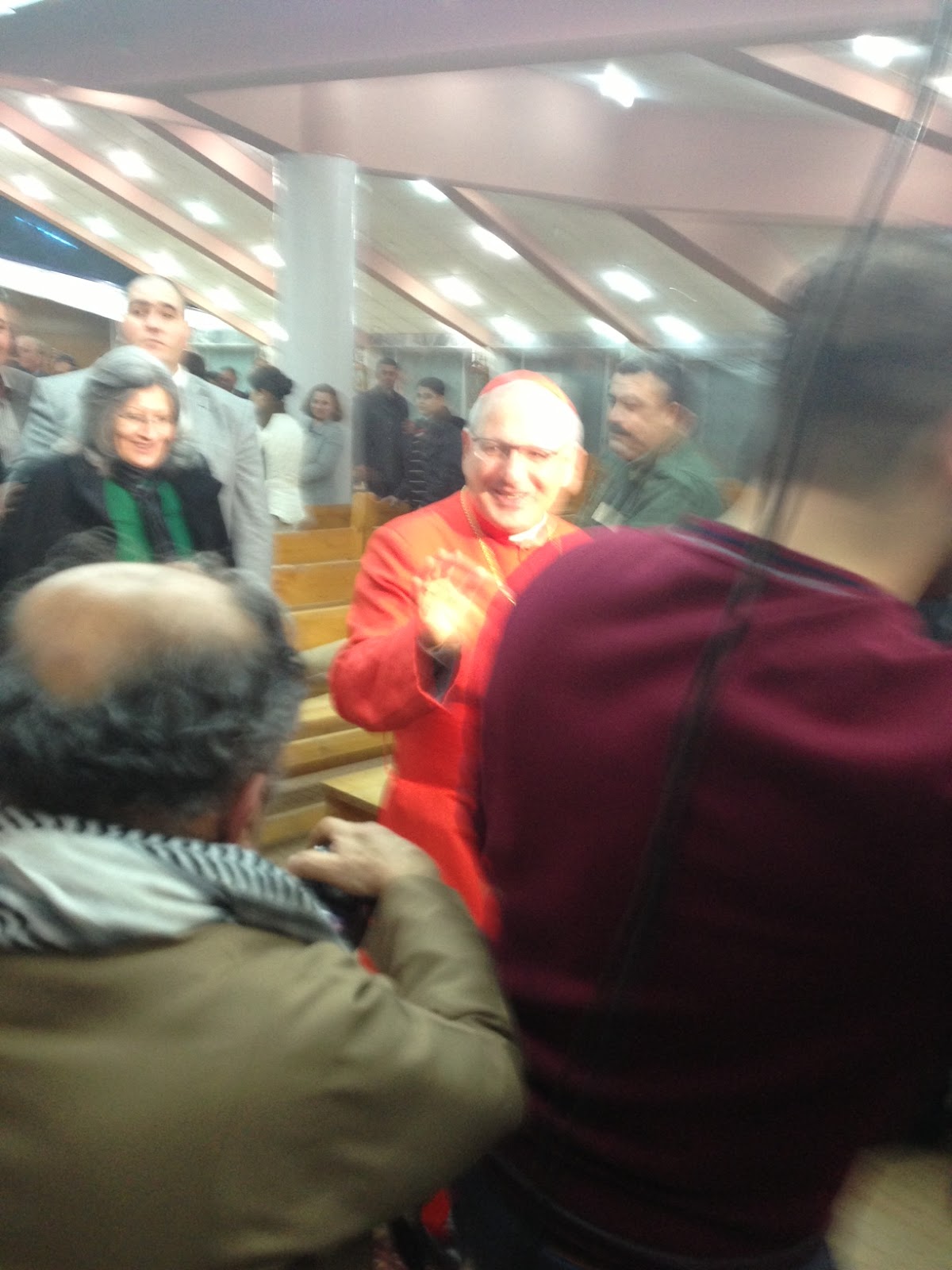
The same week, I was invited to a reception for the new patriarch of the Catholic Chaldean church, Luis Sako, who was until then Kirkuk’s bishop. This celebration contrasts last week news of the pope’s resignation. Patriarch Sako gave a touching but pragmatic speech about tolerance and the need to work together for a pluralistic Iraq. He has a tough task in front of him of building the bridge  uniting Iraq.

Patriarch Sako, after his address followed by the wife of Iraq's president Khero Talabani. 

On Valentine’s Day, I attended a concert featuring the Kurdish String Ensemble and Tara Shaf, a famous Kurdish singer that with her beautiful voice together with the harp gifted the public with traditional Kurdish songs. It was nice to see that there were young and old enjoying classical music here in Suleimaniya.


It’s starting to look like spring, and on Friday we went for a hike in a nearby village, like 40 minutes from the city. We walked through amazing nature, also full of history: this place was once the shelter during Saddam’s attack of the Kurds during the 1980’s and the Iran-Iraq war. One of our colleagues showed us a small cave were he and his family used to hide for 7 months in a time of constant shelling. It was hard to believe that among all the beauty, there is also a story of war and suffering. As the saying goes the Kurds have “No friend but the mountains”.  
Beautiful views even before Spring starts
All that happened on the backdrop of tenths of thousands of Iraqis protesting on the western provinces of Iraq, against what they see as sectarian division and corruption. The demonstrations, which have been ongoing for nearly two months, have consistently urged for the ouster of Prime Minister Nuri al-Maliki while criticizing the alleged targeting of minority Sunnis by the Shiite-led authorities. The protest have been taking place on Friday’s after prayers on the cities of Anbar, Ramadi, Fallujah, Mosul and Samarra, and the protestors have been threatening to take them into the capital Baghdad. SO far, the government has imposed movement restriction in major cities on Fridays. Civil society organizations in Baghdad went to visit the protesters last week and to show support for their demands, saying that the government should respect the right of protestors to demonstrate freely. Provincial elections are scheduled for April and as tensions are escalating, there is increased fear of protests turning violent. I don't want Iraq to turn into a Syria like war. Iraqis have seen enough blood, war and suffering for the last 30 years...

Thousands demonstrate in the western province of Iraq, could this be the beginning of a Syria like civil war?

Staying warm after a long hike

Monday, November 26, 2012

Women, Life and Freedom in Kurdistan, International Day to End Violence Against Women


"Millions of women and girls around the world are assaulted, beaten, raped, mutilated or even murdered in what constitutes appalling violations of their human rights. [...] We must fundamentally challenge the culture of discrimination that allows violence to continue. On this International Day, I call on all governments to make good on their pledges to end all forms of violence against women and girls in all parts of the world, and I urge all people to support this important goal."
Secretary-General Ban Ki-moon
Message for the International Day for the Elimination of Violence against Women

25 November 2012

Women's activists have marked 25 November as a day against violence since 1981. This date came from the brutal assassination in 1960, of the three Mirabal sisters, political activists in the Dominican Republic, on orders of Dominican ruler Rafael Trujillo (1930-1961).


Today, the International Day for the Elimination of Violence, is a day to remember those women who have fallen victims of violence. Here in Iraqi-Kurdistan, women know violence very well; they are killed in honor related violence, as a cleansing for family’s honor. That is acceptable in Kurdish society, dominated by patriarchal and tribal customs.  If a woman is a “bad woman”, she is to be killed; the problem is that being a bad woman means not submitting to local customs of early or force marriage, or even being raped.

Today, in Suleimaniya, in Iraqi-Kurdistan, women, men and children gathered to hold a memorial for those women killed in honor related violence, among them Mamosta Sakar (28) and Nigar (15), killed earlier this year. Suleimaniya, in one hand is one of Iraqi-Kurdistan more progressive cities, with a lot of women advocating for freedom and equality, on the other hand it has to deal with one of the highest incidence of honor killings.

Memorial for Kurdish women victims of honor killings
Children were also speaking out against violence
 The memorial testified to the continuous women injustice in the form of rape and murders. Men stood around looking at the names laying on the floor besides flowers and women shoes. Holding banners and pictures on the street, people stopped Suleimaniya’s main street traffic for a couple of minutes, chanting “ Women, Life, Freedom” and “ Stop the Killing of Women”. One of those caught in traffic yelled: “Four women are worth one man”.

On the sidewalk, some children also gathered holding the pictures of the women murdered and even a little girl, maybe a year old joined them, holding in her little hands the picture of Mamosta Sakar as if saying: I am protesting the killing of women, I want to have my rights when I grow up. The event closed with participants letting free white balloons on to the sky, symbolizing the white ribbon campaign. 
Women and men stopped traffic on Suleimaniya's Main Street to demand the end of women killing and freedom and respect for women. November 25th, 2012


My voice counts, stop killing women in Kurdistan.
Photo by Johanna Rivera, People Development Association, Suleimaniya, Iraqi Kurdistan
A baby holding a picture of Mamosta Sakar, murdered by her father in the village of Sarkapkan on Feb. 5th 2012
Photo by Johanna Rivera, People Development Association, Suleimaniya, Iraqi-Kurdistan

The White Ribbon Campaign (WRC) is the largest effort in the world of men working to end violence against women (VAW). In over fifty-five countries, campaigns are led by both men and women, even though the focus is on educating men and boys. Photo: Johanna Rivera

Women rights organizations that organized this event are part of Zhiyan Group, a group that was formed in August 2012 with more than 60 organizations that are advocating against honor killing in Kurdistan.

How long are we going to keep silence and be complicit against the killing and violence against women?

From peace at home to peace in the society
Bahar Munzir, reading the press release about the activities in the International Day to End Violence Against Women. The activities will be running for 16 days.