Women in Bastan Village, Kurdistan
Showing posts sorted by relevance for query protests. Sort by date Show all posts

Monday, March 14, 2011

From Sulaymania to Erbil: Repalcing the In Sha Allah, Erbil, Iraqi-Kurdistan

The other day I took a taxi back home. As I was talking to the taxi driver, a young Kurdish man, who was 27. I asked him if he was married, and he said no, that he didn’t have money. I said “Don’t worry, In Sha Allah (God willing) you will find a wife’ and he replied “I have been waiting for four years for that “ In Sha Allah” and nothing has happened.

While this conversation happened in Erbil, there have been demonstrations in Sulaimanya-the second largest city in Kurdistan and cultural capital- since the past three weeks, when citizens of Kurdistan took to the streets to demand jobs and the end of corruption. About 8 people have died so far and more than 200 have been wounded in clashes between protesters and heavily armed militia forces linked to the two ruling parties of Iraq's semi-autonomous Kurdish region. The ruling Kurdistan Democratic Party (KDP) government did not condemn the killings of civilian perpetrated by its own militia, while Mr. President Massoud Barzani, was receiving the Atlantic Peace Award in Italy.

The banner reads: GO OUT. Thousands of protesters in Maydani Azadi, Sulaymania province of Iraqi-Kurdistan


Also Aswat al-Iraq news agency reported a group of armed men set fire to the office of the Kurdish NRT Channel in northern Sulaimaniya and wounded one of its guards. The network was the only broadcasting the Kurdistan demonstrations and the killings that started on February 17th.
The University of Salahadin was closed and the non- erbilian students have been sent home out of Erbil by force. The students have not done anything wrong. Mr. Dlawar Abdulqadir, the Minister of High Education, has called for the reopening of the university and the return of the non-erbilian students to their dormitories, but the KDP has forbidden this.

In a news report from AK News, it was stated that the protesters in Sulaimaniya accused the Kurdish authority of "monopolizing the political and economic authority." On the first days of their protests, they chanted "down, down," with the leaders of the KDP and the PUK. Though the slogan wording has changed, its essence has remained consistent; they demand "reform, the end of corruption and the monopolistic power, better living conditions, and employment." Many pointed out attachment to either of the major parties was a "must" to get employed and hence were deprived from the right.

The President Massoud Barzani spoke to the people in Erbil on March 11, in the citadel, and stated that no one will threaten the stability of Kurdistan, meanwhile has refused to listen to the thousands protesting for the past three weeks in Sulaimannya. The Kurdish Parliament has held 6 emergency sessions and rejected a vote of no confidence in the current government 67-28 in the 111-seat parliament

Gorran (one of the biggest opposition parties) called late December for dissolving the current Kurdish government and parliament and allowing for a transitional government and early elections.

Gorran enjoys wide support in Kurdistan region. It has emerged in regional elections in 2009 as a rival to the two main ruling Kurdish parties and won 25 seats in the parliament. Gorran is challenging Talabani's PUK (Patriotic Union of Kurdistan), and the KDP (Kurdistan Democratic Party), of regional president Massoud Barzani and accuses the parties of corruption. It’s headed by the former senior PUK-leader Nawshirwan Mustafa, who was Talabani’s deputy until 2007. Since the July 2009 elections in which it secured almost a third of the seats of 111-member Parliament of Kurdistan.

The yellow represents he area covered by the Kurdistan Demcratic Party (KDP) and the green which covers the Patriotic Union of Kurdistan (which includes Sulaymania where the protests have been taking place since February 17)


Massoud Barzani, the KDP chief and current Kurdistan president, and his relatives control a large number of commercial enterprises in Iraq's Kurdistan region with a gross value of several billion US dollars. The family is routinely accused of corruption and nepotism by Kurdish media as well as international observers. One important thing to note is that the dominant political parties in Iraqi Kurdistan -- Barzani's KDP and Iraqi President Jalal Talabani's Patriotic Union of Kurdistan -- both have their own militias.

The situation looks different in Erbil province (where I live). Here, the KDP have cruelly prevented people from demonstrating and assembling to express their legitimate grievances. The KDP has distributed its forces, which have different names and organization such as Zerevan (special commando forces belonging to the Barzani family), Parastn (the intelligence unit of the KDP), Qutabian (the Student Union of the KDP), Asayesh (the security forces belonging to various areas of the KDP area), and other special party forces in both military and civilian clothing, in the city of Erbil and the surrounding areas. KDP forces have detained and tortured individuals who have not committed any illegal actions. The regional president of Iraqi Kurdistan, Masoud Barzani, has repeatedly said that the people have the right to demonstrate freely. What actually happens not only contradicts Barzani’s claims but is a cruel violation of human rights. Amnesty International and Human Rights Watch both issued statements urging investigations and criticizing the use of force against peaceful demonstrators.

The banner reads Hawler-Erbil: Be my friend in Ending corruption.


But despite of all the injustice, torture, killings and the government deaf ears, people believe there is hope. They go every day to protest, with songs, poetry, art, speeches and everyone is allowed to participate, at the end of the day, they clean and go home to rest. “Clean it and leave it ready for tomorrow”, the protesters leave but their banners stay on the walls of Maydani Azady. The events of February 17th, uncovered the regime and its illegitimacy. Now people know who their rulers are and what they are capable of. The mask was put off and the Insha Allah has been replaced by concrete demands for action.

Tuesday, August 27, 2013

Journey through South Iraq: Being the change you want to see in the world


Notes from the Field: From Nasriya to Diwaniya, South Iraq, June 29th, 2013

Be the change you want to see in the world. M. Ghandi

On the three hour journey from Nasriya to Diwaniya part of the drive was one way only, meaning that the road was one way each side. This makes the travel more dangerous because the driver has to cross to the opposite lane if he/she wants to pass; and they always want to pass. Driving here can be dangerous, this road was nicknamed the “Death Road” because of so many accidents. To make things worst, Iraqis do not wear the seatbelt, so accidents are fatal. But my colleague told me not to worry, as he had experience driving inside and outside Iraq. In practical terms, he drove Iraqi style, but wearing the seatbelt. Nice combination!

One of the Mawkebs in the road to Diwaniya, South Iraq. Photo by Johanna. L. Rivera 
This road is the road that leads to Kerbala, one of the holiest cities for Shia Muslims after Mecca and Medina. It is home to the Imam Hussein Shrine. Karbala is famous as the site of the martyrdom of Hussein ibn Ali (Imam Hussein), and commemorations are held by millions of Shias annually to remember it. People walk from different Iraqi provinces to reach Kerbala. The road is full of mawkebs. These are resting places that receive Shia pilgrims. Mawkebs welcome in pilgrims to sleep, eat or rest while on their pilgrimage; a kind of Camino de Santiago in Spain for Christians. The mawkebs are free and are financed by the town’s people. They believe that by such acts of hospitality, Allah will grant them blessings. 

A pair of young Iraqis hosted us for lunch in Nasriya. One of them helped us with translation during the seminar. One of them is an actor and the other one is a producer. We were invited to their home and when we arrived, of course, there was no electricity. It soon kicked in, and the AC started, but only for 2 hours. We were watching the Egyptian comedian that is famous for making fun of Morsi. Our pair was telling us about how is it to live in Iraq, especially Nasriya. They had been trying to organise a protest about the lack of electricity. As protests are forbidden, they were just pretending to be hanging out on the street, suddenly taking out signs that read: “Where is the electricity?” I already mentioned the issues related to electricity on my previous post, no wonder the youth is trying to organize protests to demand their government to provide basic services. They said they were dismissed with the promise that there will be electricity for 16 hours. “Not really true, they are lying”, they said.

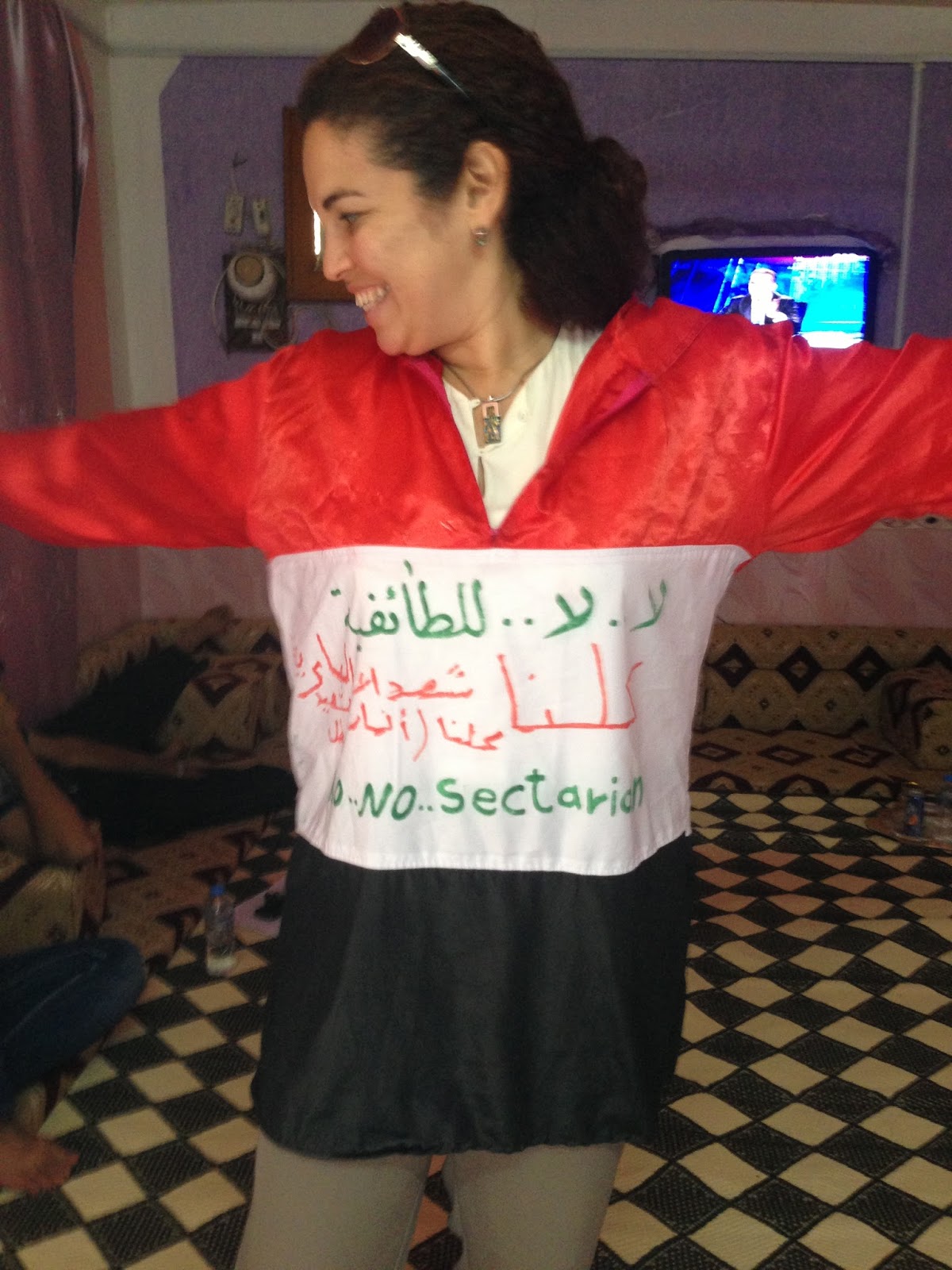
Recently, there was a big explosion in a café in Baghdad where around 40 people died, many of them youth. This sparked a big campaign all over Iraq; No to sectarianism. I saw this phrase written in a couple of places, one of them a checkpoint. Our friends in Nasriya showed me a jacket with the same slogan written. They told me they had been in Baghdad for a rally. I am humbled by the creativity and energy of Iraqi youth that are continuously challenged by an environment of violence but that refuse to give up and come with creative ways to express their opposition to violence and sectarianism.

Over dinner, we were already in Diwaniya. We were discussing about our work and Nawres was saying that she is often challenged because of her volunteer work. She is a blogger and a journalist and she is working from inside to change her society. Her motivation to work against all these challenges is that she wants to leave a print, a mark on the world. She wants to become immortal through her activism; to leave something so when she dies people remember her. She tells us that at her workplace, she is the only woman, yet she has gained the respect of her colleagues by building up her department infrastructure and systems. Another friend, who works in the Ministry of Environment, said that is not allowed to work with civil society and at the same time to be a government employee. He said that he works "low- profile".

For the last 4 days, I had the opportunity to meet Iraqi youth from Basra, Amara, Nasriya and Diwaniya provinces. These youth was not passive; they showed to be a great example of empowerment, of how to work against sectarianism. For example, like the work of a group of youth in Amara, called Team Ana Missan. They visited a hospital to deliver flowers, organized different activities like cleaning drives. In Nasriya, this group of young people have in turn organised and are demanding action from their government to solve the electricity problem that exhausts the lives of many, many Iraqis.

Some of the youth in Amara in one of the seminars about the water issues in Iraq
In Diwaniya, the youth mobilized to convince the dean of the College of Law about the importance to have a seminar to discuss the water problems and the impacts of hydropower/irrigation projects upstream. They convinced the dean by explaining that the problem was not only in the Tigris River but that everything is connected. They clarified that these dams will have big socio-economic impacts on agriculture, fishing and that the people depending on the Tigris could look into the Euphrates for a source of water, therefore affecting the way water is used in the Euphrates-Tigris basin. So, if you are overwhelmed like me from media propaganda victimizing Iraqis who live in constant violence, let these lines serve to show how the Iraqi youth is actively working to end sectarianism and violence in Iraq.

Youth in Diwaniya also self-organized a seminar in the Collegue of Law in Diwaniya

They are a living example of working to “Be the Change that you want to see in the World”

Wednesday, May 1, 2013

A Struggle for Survival and some Iraqi Lesson Learned, Ankawa, Erbil, 011211

It is a re-post as I found it on the drafts--
I am trying not to miss the details of Iraqi daily life, whether among Kurdish, Arab or Assyrian. Sometimes, I have the feeling that I am not in Iraq, in this blend of cultures, languages and peoples. The other day, one of my Kurdish co-workers came into the office, where there were three of us. He asked something in Kurdish to my other coworker, who didn't know the answer, so he repeated the question in Arabic to the other girl,  I was curious and asked him what was the question, so  for the third time he repeated it in English, only to hear that none of us could help him after he asked in Kurdish, Arabic and English.

Oftentimes it is funny, but sometimes can be very challenging. I have been improving my Arabic and learning some Kurdish. Some of my coworkers don't speak any English or Arabic, so it is really funny how I resort to creative ways of communication. I am trying to teach Sarbas, one of my co-workers , some English; sign language has proved effective for this purpose. The other day, I was talking to him in English and he was replying to me in Kurdish, and I was able to understand that he is from Suleymania, but he lived some time in Iran. He is originally from Halabja, the town that Saddam bombed with chemical weapons in 1988 (that's why his family went to Iran). He was there during 2009, when the big protests happened. Everybody here has a story, often a sad one, but they still go on, well, they don't have any other option.

Iraqis are lovely people just trying to find their way and live in this though environment. I have to say that it has been harder than Palestine. Is tough being a woman, especially in this closed, man dominated society. Women here don’t enjoy many freedoms or opportunities, they are fed up, often depressed and live under constant pressure and fear from society. They have to care about their reputation and what will people around think about them. If a woman do not wear the hijab, she is of doubtful reputation. She does not enjoy the freedom to talk to guys, to interact with male friends, because this is simply not acceptable. If she is not married at a certain age, maybe there is something wrong with her. If she likes to do something but their family does not agree, she does not have any right to do it and ultimately is her family who decides for her. For example, if she falls in love with a guy, but her family, for any reason, does not like the guy, they cannot continue the relationship, and this can even lead to the girl´s killing if she dares to disagree. They will take away the little freedoms she has (talking to her friends, etc.).

In more conservative places like Mosul or other provinces, women are harassed by neighbors or religious people and asked, why they work, or don't wear the hijab. If they want to live a normal life, they have to move, often away from their family and friends, to another city, where they don’t know anyone and they are also vulnerable because they fear that if someone recognizes them and they know they live alone (which is also unthinkable before marriage), something can happen to them or to their families that allowed them some “freedom”. Their families also suffer from this, knowing that their daughter lives alone and that at any time something can happen to her. They have to struggle with the pressure from their community/neighbors.

Even I have been a 'victim' of this pressure, and most of the time, I have to stick to the Iraqi rules. About a month ago, I met an Iraqi friend, whom I first met at UConn two years ago. He took me to the old city in Erbil and we walked around the market, it reminded me of the old city in Jerusalem. I was so excited to see him after 2 and a half years and as we were crossing the street, I said to him: “Oh my God, I am so happy to see you”, and I held his arm, (you know how expressive I am), and he almost screamed at me: “Not in front of all these people”. I am not used to contain my feelings and is very hard for me to deal with such a conservative society. He was trying to explain to me that this culture is very gender segregated because of its religious traditions. This is not always the case and depends on the family, but in general you don’t have any physical contact with men that are not your close relatives. I mean, I agree there has to be some rules, like in any ordered society, but complete segregation brings many problems. Since the interactions are forbidden, men are hungry for women and any women that they see alone, they will try to harass her.

When I went back home from Erbil to Ankawa, I took a taxi. I was going to sit in the front seat, but my friend advised me to sit in the back. Thank God, because that saved me of what was coming next....I asked the taxi driver what music was being played on the radio because I couldn’t tell if it was Arabic or Kurdish, he said it was Kurdish. I pulled a Kurdish music CD that I just got from the market and gave it to the driver. Kurdish music is very sticky and I could not help but to start dancing. WRONG....The man asked me in Kurdish (wara—come), to go and sit in the front, which I of course refused, so he tried to put his hand on my knee, and I yelled at him, NO!!!

So, that means that I could not dance because that means that I want something else with the taxi driver???? NO!!!!! Men are so desperate in such a segregated society, that any woman that smiles or even look at them is vulnerable to this behavior. That's not acceptable....So, as for me, no more dancing in public, no more smiling and no more looking at people’s eyes.....Too tough for a Latin woman. At least I will never sit in the front seat of a taxi, I learned that lesson......

Sometimes I feel I don't want to leave, and sometimes I just feel I want to run away, that I just want to sit in a cafe and talk to my friends about all the things I am experiencing here, living, eating, sleeping, working among Iraqis. How privileged and blessed we are. Yesterday, I was holding a little girl, from Khabat, she was so cute. Her father was killed two years ago; her mother, so young and widow!!!! But she was still smiling....These are the complexities of Iraq; a country, that makes me cry and laugh, that I am still struggling to understand, but also make me reflect about so many things. Sometimes I miss Palestine and wish to be there. Even though is hard, I am holding on, to every moment, every person, every story and every image, so I can later recount them to you. Its hard to keep every detail, but I am trying to do my best.

Thursday, May 2, 2013

Journal from Iraq: Global Solidarity, Transboundary Water and the Challenging Work of Saving a River

May 2nd, 2013, Sulaimaniya, Kurdistan, Iraq

I've been off writing for a long time. Lately,  a sense of overwhelming has won me. Since last March, I was extremely busy with a lot of travel, which I love, but I get tired and often sick. Working on an advocacy campaign to protect Iraq's right to water has been the most amazing experience of my life, personally and professionally, but also a very demanding  task both physically and emotionally. 

In March, I was in Tunis, for the World Social Forum and had the opportunity to share experiences with other water activists and community organizers from all over the world. We organized a session on global solidarity against water grabbing by mining and dam projects with other two groups from Turkey and Latin America. It was amazing and we got to meet people from Peru, Mexico, India, Turkey and share experiences on the same issues: water grabbing.  Then I went to Basra, to be part of the first green festival on the Iraqi Marshes. I was denied entry, and deported back to Turkey. 

In Tunis, at the Climate Space talking about our session on dams and mining projects

From there, I traveled to Hasankeyf to share our struggle with the people who's lives will be directly impacted by the Ilisu dam. People in Hasankeyf  have been living in limbo for the past 10 years due to lack of certainty about the project's plans.
View of the Hasankeyf Artukid Bridge and the Tigris River
At the Green Festival in Suleimaniya with material
about the Save Tigris Campaign
Then back in Iraq, April saw a rise in violence, killing of protestors, and activists and an increase in the sectarian divide. That is discouraging and makes you reflect if your work is worthy. If I think about my work, its exciting and unique. A friend asked me yesterday what does a normal day looks like. There is no normal day, but this is how one of my days might look like: I could be speaking to Iraqi activists about how to strategize for next awareness workshop on water issues in Iraq, talking to international law experts getting legal advice on how to make people/government/transnational companies accountable for human rights or environmental law violations related to  dams projects affecting Iraq. To academics on transboundary water issues between Turkey and Iraq and the impacts of dams on Iraqi water resources. To journalists, explaining the aim of our advocacy campaign, or to common people about the importance to take steps to demand politicians to take action to protect Iraqi water resources.

I could be on any stretch of the Tigris River in Turkey, or in Iraq, or in the Iraqi Marshlands visiting the communities that will be affected by dam projects and explaining the efforts to protect Iraq's water.
A woman on the Iraqi Marshes in Chibayish, Nasriya province. The marshes are located in three of the south provinces of Iraq, Nasriya, Missan and Basra. 
Kids playing on the banks of the Tigris River in Hasankeyf, Turkey. This town is full of historical sites and is threatened to be flooded by the construction of Ilisu dam. The campaign I work, is to raise awareness about the impacts of this dam in Iraq and Turkey.

Taking to Iraqi Media after one of our seminars in south Iraq

All this is super interesting, but is natural to be tired and even discouraged, because as colleagues from Mexico shared with us, “these are long and tiring fights.” It is easy to get discouraged when you see or hear in the news what politicians really prioritize here in Iraq. The Iraqi government’s priority is to crack on protests, increase sectarian division, exploit the country’s resources for their own interest, while keeping people hostage, to surrender to the power –in the case the Shia majority to Maliki because he is the sole protector of the Shia majority population- and to look to their own political interests:  to consolidate power. The name of the game is Fear. On the other side, Turkey continues to appropriate water that belongs to Iraqis.

On a hiking trip to Kani Shook, one of the amazing canyons in Suleimaniya.
So how do I keep my sanity and motivation? In Spanish, there is a saying: “There is no calamity that last 100 years, nor body that can resist it.” When I m overwhelmed, I try to go into nature. Here in the north of Iraq, there is amazing nature, canyons, rivers, and mountains. Being in nature helps me to forget and to relax.

I trust that Iraqi people soon realize that division and sectarianism are not ingredients to develop a democratic and inclusive society. They must stop being fearful, and start to challenge the structures that prevent development. After years of war and dictatorship, Iraqis must work together to build a place based on inclusion not division, transparency, not corruption, redistribution of wealth [and Iraq has big wealth], and justice and protection of their environment. When they understand that those who want to bring fear and terror are the ones that benefit from a terrified population, that keep their power by instilling fear, then breaking the cycle of fear, will set them free. That, of course has a price; it does not come the easy way. That is part of history, no people have been granted freedom and justice; they have fought for it. I thin we have lost many, probably too many and is time to recognise that violence and terror cannot last forever.

Sunday, February 17, 2013

Between politics, culture, nature and religion in Iraqi-Kurdistan


This week has evolved in a series of diverse events. If you want to know what a week in North Iraq’s Kurdistan Region looks like, here it goes: on a single week I have been to the court, the church, the mountains and to a music hall here in Suleimaniya. Sounds like busy fun, huh!  I was in the court to follow an honor killing case, to a reception for the new Chaldean Catholic Patriarch, to a concert featuring Kurdish String Ensemble, and to the mountains were Kurdish Peshmerga fought Saddam and families took refuge from constant bombings; while at the same time, tenth of thousands of Iraqis demonstrating on the streets against government sectarian divisions and unjust treatment of Sunni Muslim minorities in Iraq. ANd one cannot be in this region and not follow closely what is happening in Syria.....Stressed, who, me?


On Monday, I was in Suleimaniya’s court for the hearing of a case of a young woman murdered by her father on February 2012. Her name was Sakar and she was a 28 year-old teacher. The case of Sakar mobilized activists and women rights organizations who started a long advocacy campaign. Supported by more than 60 human rights organizations and activists in Kurdistan, this yearlong campaign has featured demonstrations, TV, radio and newspaper coverage together with meetings with the government to denounce violence against women and demand accountability from the government. Our efforts gained the attention of the Prime Minister and the eventual re-arrest of the father, after he was released last September.

The same week, I was invited to a reception for the new patriarch of the Catholic Chaldean church, Luis Sako, who was until then Kirkuk’s bishop. This celebration contrasts last week news of the pope’s resignation. Patriarch Sako gave a touching but pragmatic speech about tolerance and the need to work together for a pluralistic Iraq. He has a tough task in front of him of building the bridge  uniting Iraq.

Patriarch Sako, after his address followed by the wife of Iraq's president Khero Talabani. 

On Valentine’s Day, I attended a concert featuring the Kurdish String Ensemble and Tara Shaf, a famous Kurdish singer that with her beautiful voice together with the harp gifted the public with traditional Kurdish songs. It was nice to see that there were young and old enjoying classical music here in Suleimaniya.


It’s starting to look like spring, and on Friday we went for a hike in a nearby village, like 40 minutes from the city. We walked through amazing nature, also full of history: this place was once the shelter during Saddam’s attack of the Kurds during the 1980’s and the Iran-Iraq war. One of our colleagues showed us a small cave were he and his family used to hide for 7 months in a time of constant shelling. It was hard to believe that among all the beauty, there is also a story of war and suffering. As the saying goes the Kurds have “No friend but the mountains”.  
Beautiful views even before Spring starts
All that happened on the backdrop of tenths of thousands of Iraqis protesting on the western provinces of Iraq, against what they see as sectarian division and corruption. The demonstrations, which have been ongoing for nearly two months, have consistently urged for the ouster of Prime Minister Nuri al-Maliki while criticizing the alleged targeting of minority Sunnis by the Shiite-led authorities. The protest have been taking place on Friday’s after prayers on the cities of Anbar, Ramadi, Fallujah, Mosul and Samarra, and the protestors have been threatening to take them into the capital Baghdad. SO far, the government has imposed movement restriction in major cities on Fridays. Civil society organizations in Baghdad went to visit the protesters last week and to show support for their demands, saying that the government should respect the right of protestors to demonstrate freely. Provincial elections are scheduled for April and as tensions are escalating, there is increased fear of protests turning violent. I don't want Iraq to turn into a Syria like war. Iraqis have seen enough blood, war and suffering for the last 30 years...

Thousands demonstrate in the western province of Iraq, could this be the beginning of a Syria like civil war?

Staying warm after a long hike