Women in Bastan Village, Kurdistan
Showing posts with label non-violence. Show all posts

Tuesday, August 27, 2013

Journey through South Iraq: Being the change you want to see in the world


Notes from the Field: From Nasriya to Diwaniya, South Iraq, June 29th, 2013

Be the change you want to see in the world. M. Ghandi

On the three hour journey from Nasriya to Diwaniya part of the drive was one way only, meaning that the road was one way each side. This makes the travel more dangerous because the driver has to cross to the opposite lane if he/she wants to pass; and they always want to pass. Driving here can be dangerous, this road was nicknamed the “Death Road” because of so many accidents. To make things worst, Iraqis do not wear the seatbelt, so accidents are fatal. But my colleague told me not to worry, as he had experience driving inside and outside Iraq. In practical terms, he drove Iraqi style, but wearing the seatbelt. Nice combination!

One of the Mawkebs in the road to Diwaniya, South Iraq. Photo by Johanna. L. Rivera 
This road is the road that leads to Kerbala, one of the holiest cities for Shia Muslims after Mecca and Medina. It is home to the Imam Hussein Shrine. Karbala is famous as the site of the martyrdom of Hussein ibn Ali (Imam Hussein), and commemorations are held by millions of Shias annually to remember it. People walk from different Iraqi provinces to reach Kerbala. The road is full of mawkebs. These are resting places that receive Shia pilgrims. Mawkebs welcome in pilgrims to sleep, eat or rest while on their pilgrimage; a kind of Camino de Santiago in Spain for Christians. The mawkebs are free and are financed by the town’s people. They believe that by such acts of hospitality, Allah will grant them blessings. 

A pair of young Iraqis hosted us for lunch in Nasriya. One of them helped us with translation during the seminar. One of them is an actor and the other one is a producer. We were invited to their home and when we arrived, of course, there was no electricity. It soon kicked in, and the AC started, but only for 2 hours. We were watching the Egyptian comedian that is famous for making fun of Morsi. Our pair was telling us about how is it to live in Iraq, especially Nasriya. They had been trying to organise a protest about the lack of electricity. As protests are forbidden, they were just pretending to be hanging out on the street, suddenly taking out signs that read: “Where is the electricity?” I already mentioned the issues related to electricity on my previous post, no wonder the youth is trying to organize protests to demand their government to provide basic services. They said they were dismissed with the promise that there will be electricity for 16 hours. “Not really true, they are lying”, they said.
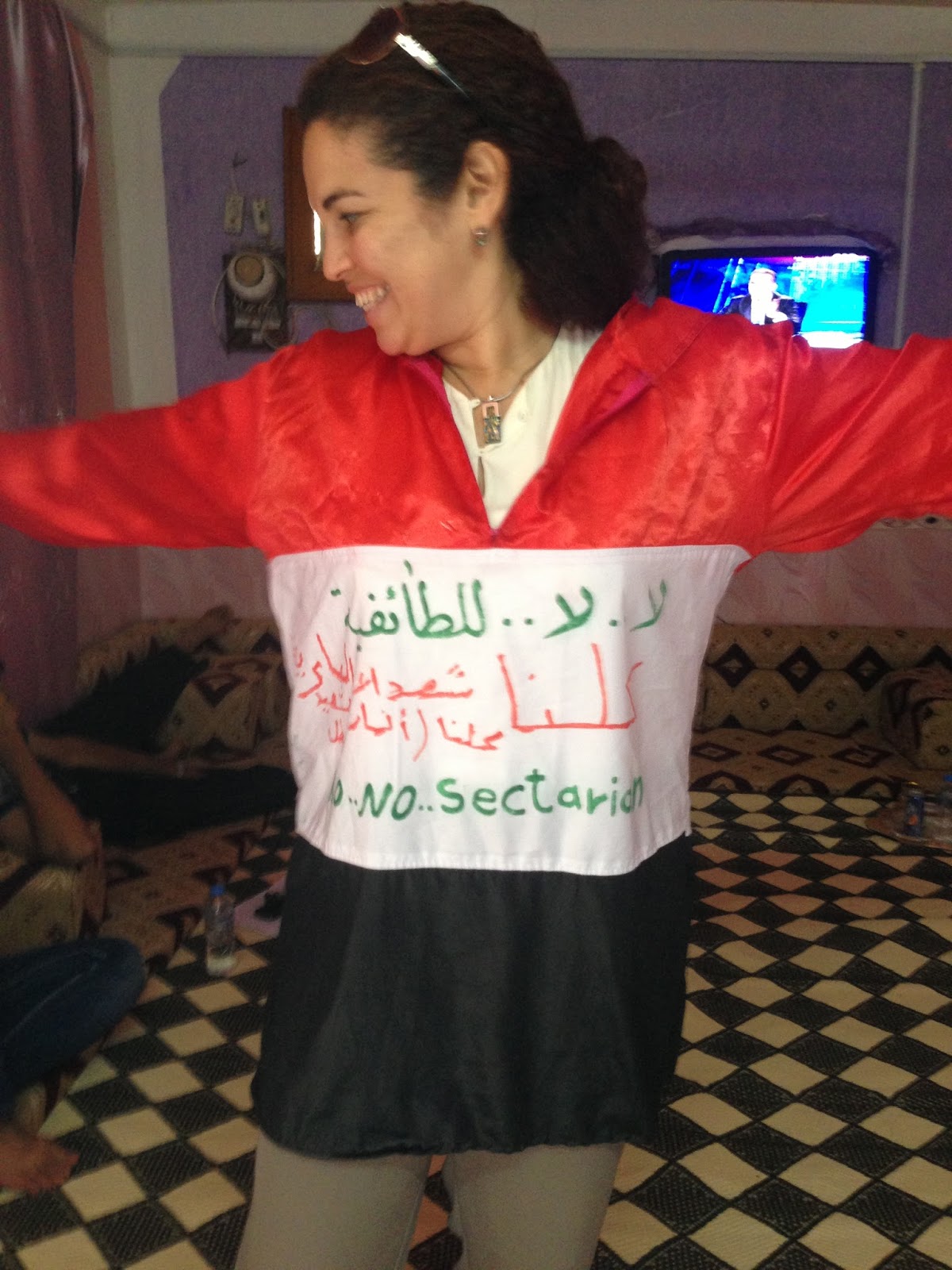
Recently, there was a big explosion in a café in Baghdad where around 40 people died, many of them youth. This sparked a big campaign all over Iraq; No to sectarianism. I saw this phrase written in a couple of places, one of them a checkpoint. Our friends in Nasriya showed me a jacket with the same slogan written. They told me they had been in Baghdad for a rally. I am humbled by the creativity and energy of Iraqi youth that are continuously challenged by an environment of violence but that refuse to give up and come with creative ways to express their opposition to violence and sectarianism.

Over dinner, we were already in Diwaniya. We were discussing about our work and Nawres was saying that she is often challenged because of her volunteer work. She is a blogger and a journalist and she is working from inside to change her society. Her motivation to work against all these challenges is that she wants to leave a print, a mark on the world. She wants to become immortal through her activism; to leave something so when she dies people remember her. She tells us that at her workplace, she is the only woman, yet she has gained the respect of her colleagues by building up her department infrastructure and systems. Another friend, who works in the Ministry of Environment, said that is not allowed to work with civil society and at the same time to be a government employee. He said that he works "low- profile".

For the last 4 days, I had the opportunity to meet Iraqi youth from Basra, Amara, Nasriya and Diwaniya provinces. These youth was not passive; they showed to be a great example of empowerment, of how to work against sectarianism. For example, like the work of a group of youth in Amara, called Team Ana Missan. They visited a hospital to deliver flowers, organized different activities like cleaning drives. In Nasriya, this group of young people have in turn organised and are demanding action from their government to solve the electricity problem that exhausts the lives of many, many Iraqis.

Some of the youth in Amara in one of the seminars about the water issues in Iraq
In Diwaniya, the youth mobilized to convince the dean of the College of Law about the importance to have a seminar to discuss the water problems and the impacts of hydropower/irrigation projects upstream. They convinced the dean by explaining that the problem was not only in the Tigris River but that everything is connected. They clarified that these dams will have big socio-economic impacts on agriculture, fishing and that the people depending on the Tigris could look into the Euphrates for a source of water, therefore affecting the way water is used in the Euphrates-Tigris basin. So, if you are overwhelmed like me from media propaganda victimizing Iraqis who live in constant violence, let these lines serve to show how the Iraqi youth is actively working to end sectarianism and violence in Iraq.

Youth in Diwaniya also self-organized a seminar in the Collegue of Law in Diwaniya

They are a living example of working to “Be the Change that you want to see in the World”

Saturday, June 1, 2013

Notes from the Field in Iraq: Reflections in a Time of Violence

As I sit in front of my computer, reading the news about the escalation in violence in Iraq, my heart fills with sadness. According to UN reports, more than a thousand people have been killed in May. Iraq is not a distant, Middle East country, full of Muslim extremists. It is the place I live, work, and wake up every morning. I live in Sulaimaniya, far from the violence, but have colleagues and friends in Baghdad and I hear their frustration, and feel their fears of an escalating conflict. I also know that is it not a simple Sunni/Shia conflict as it is portrayed in the mainstream media.  It is full of complications and question marks.

There are two main political considerations: domestic and regional. On the one hand is the failure of the Shia/Sunni/Kurdish groups to develop a form of government that reduces marginalization and exclusion of some groups and instead creates division. Maliki’s centralization and consolidation of power undermines the authority of other groups, which serves only to weaken democracy and increases the probability of conflict. ‪There is also the increased use of identity politics to access political power. Maliki on one side is accusing the Parliament of obstructing his government performance and accuses the legislature of the security breakdown. On the other the Speaker of the Parliament, Nujaifi is accusing Maliki of controlling security and political decisions. Then the regional game: the inability to reach internal solutions leads to increased power of radical groups which see internal conflict as part of the wider conflict and gives legitimacy to the Sunni-Shia narrative. Then you have Baghdad accusing the Kurdish Regional Government (KRG) of being secessionist and using Turkey to overcome the drawbacks of its land locked and troubled relationship with Baghdad. Increased tensions between Ankara and Baghdad are because of Ankara’s support to the KRG. Baghdad claims that KRG’s autonomy threatens Iraq’s unity.

As a human rights activist living in Iraq, it is tough to see that you work every day to protect other activists, to advance rights, to demand freedom, and yet, the situation seems all but better. What have politicians and people in power put forward as solutions? One side accuses the other and they just fuel the sectarian speech. They are not ready to leave their political differences aside to work for a safe, and democratic Iraq. Why, because they benefit by this state of chaos, they get to stay in power and continue to rip personal benefits at the expense of Iraqis.

I call for Iraqis to stop thinking on what divides them and start thinking on what unites them. To put an end to sectarianism, division, and ethnic divide. This is not a call for arms, is a call to re-think the Iraq that we want to see and live in. What is the Iraq we wish to leave for future generations? Iraqis have lived at war for 40 years. They are resilient and strong people. In fact, I am working on a daily basis with great people who want to advance their country, have equal gender rights, a democratic, and a participatory democracy.

There are people in Baghdad, Erbil, Basra and in every Iraqi city that work every day to advance rights and freedoms in Iraq. I work with some of them.  I hear their frustrations during this time of increasing violence; their work like mine is being tested. Moreover, some of my colleagues are working on an Iraqi Social Forum under the theme: Another Iraq is Possible. Now, more than ever, they need our support and solidarity. To plan such an event is very challenging under the current circumstances. Now more than ever, they need international solidarity, to share experiences from others that have succeeded, that have rebuilt their countries, that have overcome differences and have decided live together.  

What has Maliki’s government brought to Iraq? Peace? Development? Democracy? Democracy does not happen overnight (as some might have thought), it is a process. In order to have democracy there must be the economical and social infrastructure in place to support it. That requires people participation and people need to feel safe, and that they have a legitimate government that is able to protect them. This will not be achieved under the banner of sectarianism or accusations but united and working to bring about justice and an end to violence.

I really believe another Iraq is possible, I believe in the power of people. Iraq has young people full of dreams, people who believe in human rights and justice, and the environment, who do not buy this sectarian propaganda. Young, intelligent people that are capable of constructing their future, and using Iraqi resources to the best of its potential, and to compete in the global market of ideas. These are the kind of people whom the government is afraid of. Lets not be afraid, let’s start this revolution of ideas and to think how to rebuild our country. Unite and conquer, that should be our banner for a new Iraq.

Tuesday, October 30, 2012

Basra Peace Run: Yes, Yes to Peace-- Basra, Iraq


Imagine this: running in the streets of Basra, Iraq in the name of peace and non-violence. Retaking the streets. The slogan: Basrah, city of peace…Iraqis discussing the issues that most matter to them. This is not a product of my imagination, it actually happened last weekend and it was historical. The best part; I was part of it.
Running Line, Basra Peace Run, Basra, Iraq. Photo by Laura Battaglia

Basra Peace Run, Basra, Iraq. Photo by Laura Battaglia

Young people in Basrah took back their streets through a peace run. For some hours the streets of Basrah felt the sound of peace. Being the only woman running felt initially scary, but special. All people around me, especially children were encouraging, including the police guarding the run, which pushed their guns aside and were filming with their mobiles, smiling and affirming that peace was in the air. The participants were chanting: naam, naam li salam! Yes, yes to peace!

Award for the slowest and fastest runner of my category.
Basra Peace Run, Basra, Iraq. Photo by Laura Battaglia

Everybody won the race, the people of Basrah won and peace won. For sure this is the start of many other sports events reaffirming that Iraq is moving towards a future of peace.


At the same time in the north of Iraq, in the Kurdistan Region’s capital, Erbil, 5000 people representing 40 countries ran on a similar event.

Sometimes imagining the impossible can make things possible. As I was arriving to the finishing line, an Iraqi man came to me and smiling gave me a thumbs up and with it handed me a medal from the Iraqi National Football Team, as an affirmation of peace. Eventually I got another medal. I guess I was the only one in may category. I felt very blessed and humbled.

Basrah, once the garden of Eden, now recovering from decades of war, a city of peace with its beautiful people and a symbol of what the rest of Iraq will be in the future.

Running for Peace in Basra. Photo by Laura Battaglia

Sunday, January 16, 2011

Thoughts and Reflections for the New Year—Iraq 123110

How do I start gathering my thoughts about this year of 2010? First, I have to say that it has been a very productive one. A year full of changes, challenges, and decisions made, of letting go of some things and people and embracing others, losing but mainly gaining. A lot of traveling, and when I say a lot, is a LOTTTT! From NY to Cairo and back, and then back again….

In Cairo, holding the PR flag, full of puerotrican children's hands in solidarity for the children in GAZA, December, 2009. 
I started and ended my year in the Middle East. Last year, on New Year’s Eve, I was in Cairo, in my first international activism mission. I took part on the Gaza Freedom March, an international delegation that gathered around 1,400 people in Cairo, whose purpose was to challenge the siege of Gaza. It was the first anniversary of Operation Cast Lead, and we wanted to get the world’s attention on the approximately 1,400 people killed by this unjust Israeli attack on civilian population. Although most of us didn’t make it into Gaza, we stayed in Cairo for a week, annoying the Egyptian government, also complicit of the siege, for enforcing Israeli policies and for not letting us get into Gaza. We did actions and demonstrations every day; from climbing the pyramids and hanging the Palestinian flag, to the biggest international gathering on Dec 31st near the Egyptian Museum.


I remember that, when everyone was getting ready for the New Year to come, we were getting ready to make our voices heard. More than 500 people from 42 countries gathered and came out to the street in front of the Egyptian Museum paralyzing the traffic. Immediately, we were confronted by the Egyptian riot and undercover police, that had been all week following us. They started to kick people and to try to break the demonstration.

During the demonstration on December 31st, 2009, Cairo, Egypt. Photo by Johanna L. Rivera.
The sense of unity that I experienced was incredible. Everybody was holding each other, while being beaten or kicked, or women being pulled by their hair. I remember a guy that held me and hugged me after I was shocked and crying because of my confrontation with the police (I was not beaten, but still was PTSD). This guy whom I didn’t know was holding me and I experienced a sense of peace and comfort. The people's bonding and unity was amazing. It was the same feeling I experienced last November, on one of Beit Ommar's demonstration when being teargassed by the IDF. The feeling that no one can break the unity and strength that comes from standing for justice and truth. It almost feels that your spirit rises and you are so powerful and not afraid of what can happen.

I imagine that was the same feeling that activists from the Freedom Flotilla felt when their boats were illegally taken by the Israeli military (May 2010). That same spirit that makes Palestinians go on every week in Beit Ommar, Bil’in, Al Walaja and many other villages fighting in non violent ways. I guess among all my frustration and sometimes helplessness, I feel there is some hope. Hope that comes from the past months living this journey deep into the struggle. Knowing that there is evil, sure, but that there is more good. Sitting at a table around Israeli and Palestinian activists after a demo, knowing that they are fighting with the only weapons they have; their bodies and spirits and that there is no man-made weapon that can overpower truth. The Israeli military, with their US-made weapons can kill many, but they will never kill the spirit of truth; and the truth is that we are all human beings, made equal and that we don't own the land; the land owns us. And I will add that my hope, even when sometimes is mixed with tears and frustration is the only thing I can take with me on this journey, is the only thing that keeps me standing in the middle of the struggle.

The hope I got from the people at the Tent of Nations, fighting everyday against the illegal occupation of their land. They have been successful for the past 10 years from preventing the Israelis of taking over their land. Hope from my girls from Bethlehem, because in their eyes and smiles I see that we have to keep the cry for justice, so they, one day will be free to see the ocean. The hope from the bedouine people of El Arakib, rebuilding their village again and again after its 9th consecutive demolition. The people in Beit Ommar, Issawiya, that confront the soldiers every day, and stand against the occupation. The women from KAYAN working from within to empower other women to gain more social and political participation and to fight Israel's racism. The hope from ALL the people I met that work everyday to fight injustice and inequality.

In the weekly demo in Beit Ommar against the illegal appropriation of land from the farmers


But still, many questions remain. First, I want to understand what is behind all this disproportionate violence. How is it that a human being can react in such a way as to use such disproportionate violence against an unarmed civilian, to purposely KILL. Today, there were news report of a Palestinian killed at a checkpoint in Nablus, because the Palestinian attacked the soldier with a bottle. How does that work? I hit you with a bottle and you kill me, when you are the one oppressing me and taking away all my freedoms and rights on the first place. I have been on the checkpoint when there have been excessive delays of more than one hour of just waiting and one soldier on top of us, on the roof with a gun, just watching, indifferent, while smoking a cigarette how the Palestinians get anxious.

Entrance of BETHLEHEM checkpoint


Second, I want to understand what is behind these terrorist attacks here in Iraq (the main one in October 31st) , on the Christian community. How come, in the name of religion, you can justify bombing a church, although what is said here is that what caused the bombing was that the government intervened in an inappropriate way by failing to negotiate with the terrorists but went inside the church, causing the attack to be worse. I guess this mistake in strategy is political too. I don’t know about you, but it makes me ANGRY, in a different way than the Palestinian-Israeli issue makes me angry. I don’t know why or how people become so brainwashed to do such things but I know how it feels (here in Iraq) to be afraid in the very place you are supposed to find peace and lift your spirit.

I can only hope that peace will come, one person at a time, one smile at a time. I know I cannot change the way or the politics of these conflicts. If I had a magic stick and could make ONE wish come true for next year, it would be to make the first commandment true. LOVE YOUR NEXT AS YOURSELF! At least I think that would be a good start.


Children playing in Khabat village 20 km out of Erbil--Iraq their eyes and smiles help me keep on this struggle. Photo by Johanna L. Rivera


Children from Beit Ommar village in Palestine, for them I keep my hope. Photo by Johanna L. Rivera