Women in Bastan Village, Kurdistan

Wednesday, April 27, 2011

Tales from the Border Krossing--Iraqi-Kurdistan into Turkey, 041411, Between Iraq and Turkey

8:30 am—Woke up… It’s going to be a long, long day and I already started by waking up late!


10:18 am--
--> Left the house but came back shortly after to pick my jacket, the weather forecast for Turkey, Georgia and Armenia was telling me that it was going to be cold for the next week, so better be prepared.


10:26 am-->
-->On the first taxi to Erbil’s garagi shimali to take the first taxi that will bring me to the Iraqi-Turkish border. I like road trips, there is always something interesting and unexpected. I think this one is not the exception since I have no clue about where I am going and how to get there.
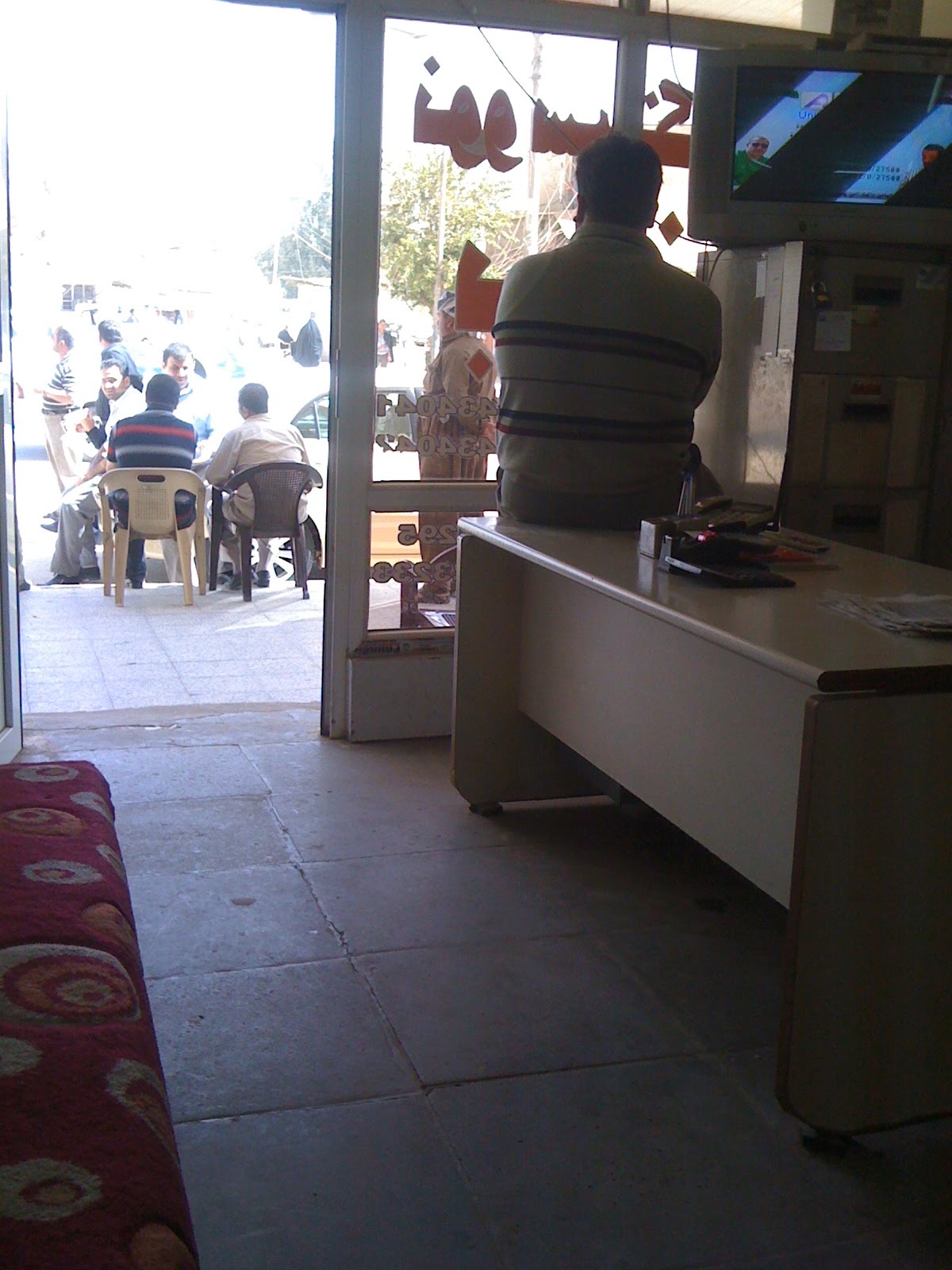
10:38 am--> -->Arrived to the taxi station. I have to wait for more people to get into a shared taxi.


11:04 am—I wear my scarf as a veil to avoid the looking on me by all men around. Maybe they will respect the fact that I am wearing it or maybe I will not catch the attention that much. Ok, we are hitting on the road. The man and woman traveling with me keep saying: ya Allah! As a sign of contempt, I guess.

11:27 am – Our driver stopped for gas, I guess we are still in the city.

11:50 am-- Entering Kalak municipality. The guy on the front got off at Duhok. After he interviewed me over what I was doing in Kurdistan and mentioned that he knew my boss and other people. He was working as an advisor for the Oil for Food program. I started to be hungry, so I opened a bag of chips. The guy on the back changed to the front, he was a Turkish –Kurd from Silopi and was working in Erbil. He was car sick and started to throw up. The lady on the back was disgusted and putting her veil on her face. The taxi driver was hesitant, almost angry to stop. Men, the guy is sick, do you want him to mess the entire car? I was normal, because everyone can get sick. I passed him my water to him and he went out of the car and washed his face.

2:21 pm-- Entering Zakho, the city at the Iraqi-Turkish border.


2:30 pm -- Me and the guy changed taxi to go to the border because the last with us was going somewhere else and was complaining so the taxi driver put us in another taxi.


2:45 pm-- Ibrahim Khalil border crossing. I followed the guy that was on my taxi, cause I figured, he is a local and he will take the cheapest way out of Iraq. We got into a minibus with other 4 guys. The guy is going to Silopi, and I wanted to ask him what is the deal Silopi - Kiziltepe , but he asks me to stay quiet (on my best interest or his?). I guess we will see!


4:30 pm --After a long negotiation, the two guys controlling who gets to pass to the other side, the guy wanted to let only one car with 4 women, one of them a Turkish girl with a neck immobilizer, the guy


said, one driver, I looked at my driver, a very skinny guy, whose eyes were a mix of sadness and frustration. I refused to leave my newly acquired driver and friends Turkish. The fatter guy let us pass either he was annoyed. My new Turkish friends were very happy and making thumbs up and me. Aghhhhhh, Johanna, always in trouble. I could have taken the direct bus into Mardin, but no, I wanted to check it out, right…….. An endless line of cars was waiting for us.


5:00 pm—Escorted by my thin taxi driver and after talking to three different officials and avoiding the long line of cars thanks to my American passport- didn’t have to do anything, just smile and say: “Puerto Rico, bilyorsun-do you know?- they say that in 10 minutes they are going to let us cross. This is only the Iraqi control and we have been here more than two hours so far. We still have to get the car inspected and move into the other border. The Iraqi customs are blaming it on the Turkish, while I ‘m trying to play the American who needs to get to the other side.


5:18 pm -- Checking our car-Iraqi side still.


5:33 pm-- Still waiting a long cue, I’m not sure why!


5:53 pm -- We are able to pass into Turkey after three hours.


6:27 pm-- Waiting for another control to check our car and then the luggage. Grabbed tea and lahmajun courtesy of the guys. A good moment to open all the secret compartments of the taxi and hide more than a dozen cigarette packs. Even I assisted on the smuggling. I asked Ayaz if he did this everything day, and of course he did not understand me but I guess I know the answer and is “Yes”.


7:45 pm-- Passed the Turkish passports control, finally, but is not over. I have to make it into an 8:30 pm bus from Cizre to Kiziltepe. I have no idea how long it takes to Cizre, so I asked the only guy that speaks a little English, which by the way sneaked in our bus on the Iraqi side, just before crossing into Turkey. “How much time to Kiziltepe”, I asked, pointing to my wrist”. He replied: ”Five”. I was confused, “Five what, minutes?” “Yes……. no”. He looked confused as well by my request. I never got an answer and later there was a sign in the road: Cizre 26 km. The guys in the back were singing Turkish songs of the top of their lungs, while I was worried if we were going to be able to make it.


8:30 pm-- Just made it into the Cizre bus station and got into the bus with some of the guys that were on my taxi. I asked one of them how long it would take to Kiziltepe and he said one hour, which I am going to find out. They are going to Mersin, 15 hours away. So, I shouldn't complain. Now, I remember that on the border, one of the taxi drivers mentioned that it was 2:30 hours. I should trust him because he must travel from here to there so I should be getting there by 11:30 pm.


9:00 pm-- Bus departs from Cizre.


9:14 pm—Stopped for some sort passport control.


9:23 pm- Back on the road.

11:30 pm—finally made it into Kiziltepe after 13 long hours. Safe but tired. Mahir was waiting there for me, even though I was thinking that he was not going to know where I was going to be dropped. End of today’s journey, but the beginning of a whole new adventure.

Sunday, April 10, 2011

On Libyan Intervention--Do you really believe the 'moral' argument, 032411, Erbil, Iraqi-Kurdistan

i
“Muammar Gaddafi, the Libyan leader, must go. But it is critical that his downfall come at the hands of the Libyan people rather than as a result of Western military intervention in the country.” Lamis Andoni, stated in an Al Jazeera article writing about Resolution 1973 authorizing a no-fly zone over Libya.

My Iraqi co-worker reminded me that in 1991, there were no-fly zones imposed on Iraq, on the beginning of the up-rising against Saddam, again, with the pretext of protecting civilians, but the real purpose, he said, was to keep him in power, until a better replacement was found. He is critical about the no-fly zone, however [as a lawyer] he recalls the duty of the international community to protect civilians being massacred by their government. “That’s state terrorism and the international community has the responsibility to protect civilians against genocide”. He affirmed.

There have been several arguments in favor and against the intervention. I am in Iraq, and what I get from the people here- not a positive reaction -is that this is the same reality that they lived under Saddam and the imposition of the no-fly zones. Not too hopeful that this is in the best interest of the Libyan people!

Lamis Andoni continues her argument by saying that “No government is free if at its very inception it depends upon external powers – powers that, in the Libyan case, have their eye on the country's oil wealth and are motivated by geopolitical interests.” The imposition of the no fly zone leading to military intervention in Libya, will lead to the country’s infrastructure being destroyed and as a consequence a less sovereign future government in Libya; and as my coworker points, they will pass the bill of every single bullet they fire, to the Libyan people and he speaks from experience….

In the same line, Richard Falk writes opposing the intervention acknowledging the Qaddafi regime as being brutal, “but does it validate a UN authorized military intervention carried out by a revived partnership of those old colonial partners – France and Britain – and their post-colonial American imperial overseer?"-- I think that the real thing goes more like: let's stabilize the oil producer country, Iraq style, bomb their infrastructure and then bring a lot of ex-pats to fix the mess, and establish an Oil for Food program. We know that it will not work.

Falk adds the point that history has proven right in giving people self-determination, even though its short term costs and highlights the problems of intervention because of its rarely good intended motivations. He rises questions on the UN vote: “why China and Russia expressed their opposition by abstaining rather than using their veto, why South Africa voted with the majority, and why Germany, India, and Brazil were content to abstain, yet seemed to express reservations sufficient to cast 'no' votes, depriving the interventionist of the nine affirmative votes that they needed to obtain authorization.”

Nicholas Kristoff in his NYT column argues in favor of intervention, he talks about Libyans holding thank you rallies in Bhengazi. In his article he points out that “The world took three-and-a-half years to respond forcefully to the slaughter in Bosnia, and about three-and-a-half weeks to respond in Libya.” He acknowledges that intervention is more likely in countries with natural resources –like Libya- but that is “worth preventing some massacres and genocide, even if we can’t intervene every time.”

Kristoff cites a senior White House official saying that the humanitarian argument was decisive for President Obama: “The president was chilled by what would happen to the people of Benghazi and Tobruk. There were critical national security and national interest reasons to do this, but what compelled the president to act so quickly was the immediate prospect of mass atrocities against the people of Benghazi and the east. He was well aware of the risks of military action, but he also feared the costs of inaction.” --What costs, the gas prices?

Now there are many questions: How many civilians are going to be killed by the western forces before Qaddafi gives up power? After Libyans get rid of their dictator, are they going to be under foreign occupation? Are western powers going to respect the sovereignty of the Libyan people or are they going to impose another dictator that serves their interest to conquest oil and resources?

Another question is: Is the situation in Libya going to discourage the current Arab revolution? The revolutions of Tunisia and Egypt have given power and hopes of change to the Arab world, hopes of democracy, justice and equality. But this will only be a reality if after the dictators fall, the local people take over without further western influence in their affairs.

L. Andoni, The children of Omar Mukhtar, http://english.aljazeera.net/indepth/opinion/2011/03/2011324111831413805.html, accesed March 24, 2011.

M.Mamdani, Libya: Politics of humanitarian intervention, http://english.aljazeera.net/indepth/opinion/2011/03/201133111277476962.html, accessed on April 4, 2011.

N.D. Kristof, Hugs From Libyans, http://www.nytimes.com/2011/03/24/opinion/24kristof.html?_r=1&hp#p[BwaBwa, accessed on April 4, 2011.

R. Falk, Gaddafi, moral interventionism and revolution, http://english.aljazeera.net/indepth/opinion/2011/03/2011322135442593945.html, Accessed on April 4, 2011

Saturday, April 2, 2011

Eat, Love and Pray in Iraqi-Kurdistan--031411, Erbil, Iraqi Kurdistan

Drinking my tears of anger, frustration and sadness. I don’t know how to deal with all the realities that I have in front of me. Many peoples; many stories. Stories that I am part of, but I wish they were not happening. Not even violent stories or people being hurt physically. It’s all an internal struggle for survival. A struggle to survive in a very tough environment, full of discrimination, fear and violence against women.

A Kurdish guy, frustrated because he is not able to provide better for his family, a very low salary job, his son with a very uncommon disease, trapped in a life that he can’t manage, overwhelmed by the political situation, a corrupted government that imprisons, torture and suppresses all opposition, despite calling itself a democracy. He does not see a way out. He wants to provide a good education and good opportunities for his children, but how.

A Kurdish girl, who’s living in constant fight with the society around her. She challenges the conventional wisdom that a girl needs to marry and take care of her husband and children. She wants to be independent, travel and learn how to help other women that are facing the same challenges as her. She doesn’t like to wear the veil, but she forced to, for the sake of not harming her family’s reputation. Her job is very stressful and challenging. She is constantly afraid of making mistakes and making her boss angry. She hopes to find an ideal man that can understand her and can be open to the fact that she wants to continue working and wants to travel and know the world.

A guy from Baghdad-an internally displaced person-like many here in Erbil, he came running away from violence and trying to survive inside Iraq (as an Iraqi and is extremely hard to go abroad). He used to have a clothes shop in the market in Baghdad, but because all the violence and explosions, the market was closed. He is away from his family; both his parents are sick. His brother in law is in jail and his sister has 4 children. He has not married because he does not have enough money to pay the dowry to be able to get a wife. He left school at an early age to work. Now, alone and away from his loved ones, not speaking the [Kurdish] language-which leaves him with less work opportunities- he has to survive in odd jobs, working 17 hours a day. He cannot complain and has to accept this, otherwise he will not be able to stay in Erbil and has to return to Baghdad.

An Iraqi girl, who also is fighting the society, she is charming and beautiful, very independent and speaks herself out. She fights for her right to be free and independent, in a society that criticizes those two qualities if seen in a woman. She struggles to keep a good job and to be able to be out of the controlling eye of her supervisor that follows her in every step, and tries to decide for her what is good or bad.

Aother Iraqi girl, she confronts a conservative society that dictates the rules that women have to follow. She says there is a line and you have to walk in that line, you have to respect society. She tries to keep herself busy to hide her emptiness. She dreams of going abroad to find her freedom. She does not blame her family whom she says are very supportive and open. She loves fashion and has found here in Kurdistan a place where she is free to wear what she wants without fearing the society’s criticism. She is very kind and loving and wishes to find a husband that takes care and understands her.

A society that still operates on a tribal base and that calls itself a democracy. A system that favors only some; those who are supporters of the ruling elites. Everything is controlled by a few that hold the power and benefit from the resources of the country. The government is opening the door for foreign investment because of its own interest and benefit, but this has its consequences: a very traditional society opening to development and globalization but yet close-minded. We don’t know yet how this will impact Kurdish society, but what we know is that this rapid economic growth brings injustice; there is no equality in the redistribution of income.

Weak institutions that only serve the interests of the few, the few that have connections to those with power. If you need something done, you need contacts, or otherwise, things are really hard to manage. On the entrance of the Ministry of Interior, where I went to get my visa, there is a woman with her children crying for help, she does not have any connections, nor she knows anyone in the government who can help her. While there are a lot of foreign workers who come to improve their life opportunities here, there are some locals, often women and children, begging on the street. I told my co-worker, if we keep going out, we will be broke, because every time we go out, there is a person who is asking for money.

International Organizations that only seek to stabilize the government because is on their best interest to have a “democracy” on an oil producer country. They are investing millions of dollars in “peace building” and “democracy promotion”, but people is too busy worried on trying to stay warm in the winter and cool in the summer, trying to get a job to provide for their family.

I guess I am upset in a way. At least I have many opportunities, as I happen to live in a democratic country [I didn't have a choice]. I can travel freely, follow my dreams…..but my friends here can’t [they didn't get to choose either].

This is a beautiful country, with a rich history, culture and great people, but also a sad history of war, genocide and fighting. My only wish is that democracy will come to Kurdistan from a freely elected government, not from fear of the past or tribalism. There is a need for the development of strong institutions that support civil society and participation in an environment that is inclusive of all, men and women. This will take time… on the meantime, I’m here, listening, sharing my sadness, tears and stories, that one day people read them and know how I feel as I Eat, Love and Pray in Iraqi-Kurdistan!!